 |
 |
 Brazil and Ceará info
Cities and places
Flora & Fauna
Videos
Contact us
Home
Brazil and Ceará info
Cities and places
Flora & Fauna
Videos
Contact us
Home
 |
|
|

Caatinga The Caatinga is a semi-arid scrub forest situated in the northeast of Brazil. It is extremely rich in natural resources but when compared to the rain forests there is little available information on its biodiversity. The Caatinga is so altered that only a few ecologically important examples of natural habitat remain. The most amazing fact is the Caatinga is unique to Brazil yet only 1% of its habitats are protected. The Caatinga occupies 11% of the Brazilian territory stretching across 300,000 square miles of the subequatorial zone. The Caatinga is one of the most populated semi-arid regions in the world and its human occupation dates back to pre-historic times. Rudimentary agriculture and the intense use of natural resources have increased degradation of the land. The Conservancy is the only international conservation organization currently working in the Caatinga. Cerrado A sprawling savanna of more than 500 million acres (1.2 million square miles) located in Brazil's central high plains, the Cerrado covers more than one-quarter of this immense South American country. Although nearly half of its historic reach has been converted to farms, this grassland remains home to 935 species of birds and nearly 300 mammals, including many endangered species. The Cerrado is the world’s most biologically rich savanna. It has over 10,000 species of plants, of which 45% are exclusive to the Cerrado. The Cerrado also feeds three of the major water basins in South America: the Amazon, Paraguay and São Francisco Rivers.
Flora and Fauna - nature
of the northeastern Brasil
The largest country in South America, Brazil’s unparalleled natural treasures include not only the dense tropical rainforests of the Amazon that covers almost half of the country. On the west is the Pantanal, the world's largest wetlands. Central Brazil is covered with Cerrado, or grassland and gallery forest habitat. Northeastern Brazil is caatinga desert, with patches of tropical moist forest on the coast. The photo gallery: Flora and Fauna 
Ubajara national park Topographic map of Brazil 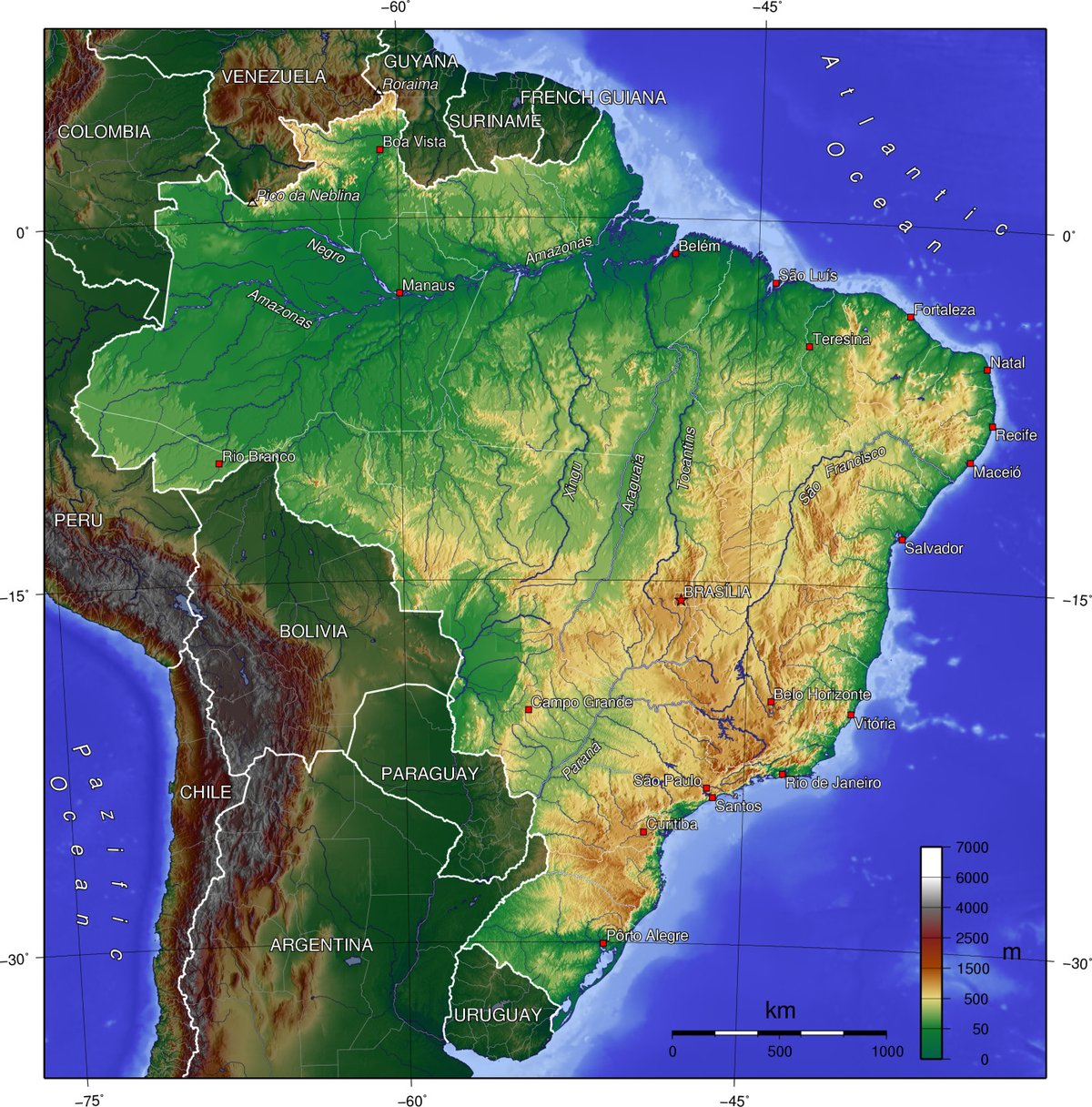
Vegetation map of Brazil 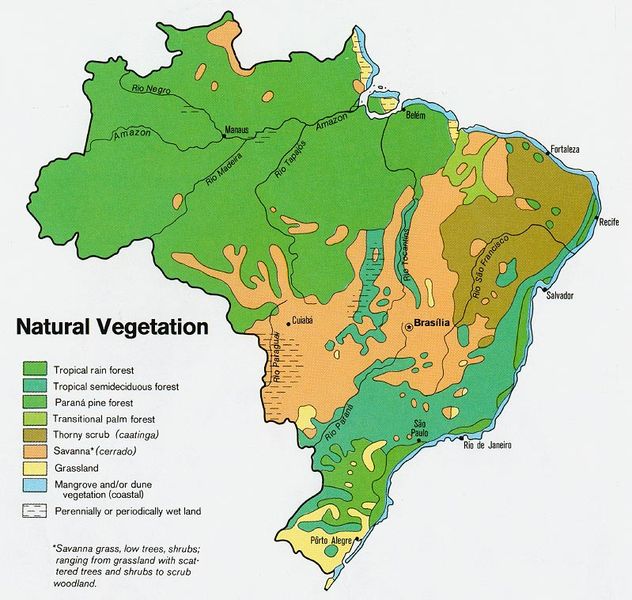
(Large images open into a new window) The coast of Ceará has a typical tropical climate, with warm to hot temperatures and high relative humidity all throughout the year. However, these conditions are relieved by a near absence of extreme temperatures and pleasant trade winds blowing from the ocean Ceará has a varied environment, with mangroves, caatinga, jungle, scrubland and tropical forest. The higher ranges intercept considerable moisture from the prevailing trade winds, and their flanks and valleys are covered with a tropical forest which is typical of the region, gathering species from tropical forests, caatinga and cerrado. The less elevated areas of the plateaus are either thinly wooded or open campo. Restinga The Northeastern Brazil restingas are an ecoregion of northeastern Brazil. Restingas are coastal forests which form on sandy, acidic, and nutrient-poor soils, and are characterized by medium sized trees and shrubs adapted to the dry and nutrient-poor conditions found there. The flora of the Northeastern Brazil restingas includes many species with affinities to Amazonia, which distinguishes them from the Atlantic Coast restingas of Brazil's eastern coast, whose flora is mostly derived from the Atlantic forest of eastern Brazil. |
| ©
Copyright A. Jokisaari |
|
|